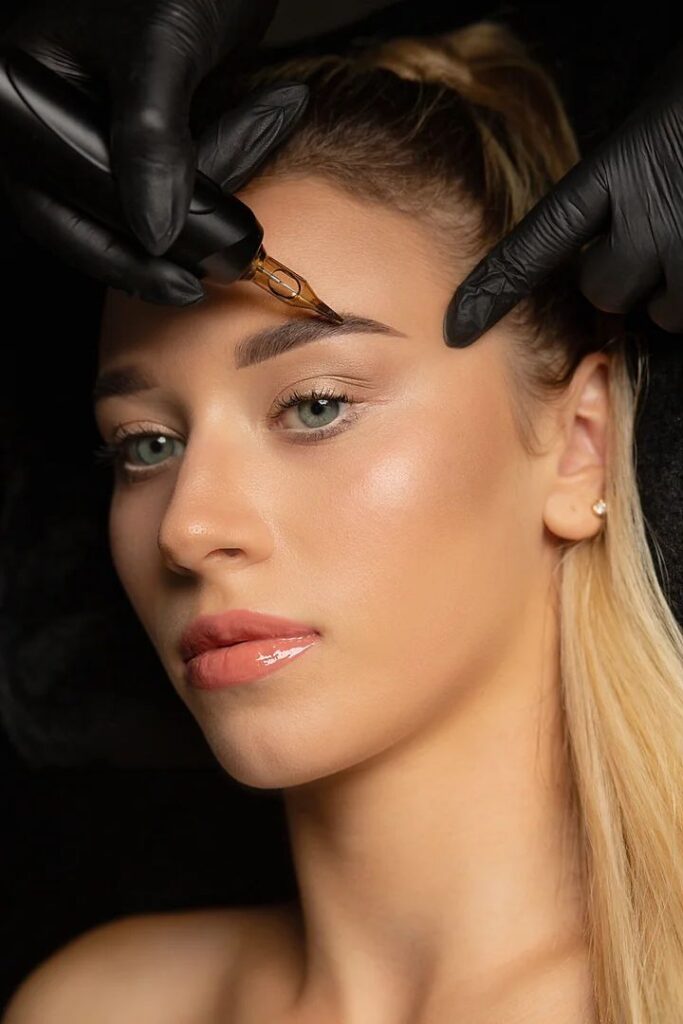
Permanent Eyebrow Makeup
Eyebrows frame the entire face and have a significant impact on its expressiveness. Permanent makeup allows for a symmetrical shape and a perfect fit to facial features – without the need for daily makeup.
- Powder/ombre method – delicate shading giving the effect of soft, natural eyebrows.
- Correction and refreshing – fixing the color and shape to keep the eyebrows looking fresh for a long time.
- I always tailor the final effect to your expectations – it can be very natural or a bit more intense, depending on the style you feel best with.
Permanent Lip Makeup
- Lip contour with shading – subtle enhancement of the natural lip line.
- Full lip color – a more defined look, similar to wearing lipstick.
- Ombre / shading – soft color transitions for a fresh and feminine effect.
Pre-treatment consultation
Medical Micropigmentation of the Nipple-Areola Complex
Micropigmentation of the nipple and areola is for many women the final step in the process of recovery and returning to themselves after cancer treatment, mastectomy, breast reconstruction, or surgical procedures such as breast augmentation or reduction. It is also used in cases of asymmetry (uneven nipples), pigment loss, loss of color, as well as to camouflage scars or discoloration. Also known as areola pigmentation, areola tattooing, or nipple-areola micropigmentation, this procedure involves depositing pigment into the superficial layers of the skin to create the appearance of a natural nipple and areola.
In practice, it resembles a medical tattoo, but softer pigments and precise shading techniques are used to create a realistic, three-dimensional effect. As a result, the nipple appears natural, and the colors are subtly matched to the skin tone and the opposite breast. Medical micropigmentation has a significant reconstructive value – it is often the final stage of breast restoration after mastectomy or surgical reconstruction. It can also be performed for purely aesthetic purposes, such as evening out color, improving symmetry, or restoring pigment intensity.
Who is nipple-areola reconstruction for?
- This treatment is intended for individuals who:
- - have undergone oncological treatment – including single or double mastectomy, wishing to restore femininity and body integrity;
- - have undergone breast surgery such as augmentation – when scars affect the appearance of the areola;
- - are in or after gender transition – to achieve a natural chest appearance and improve self-confidence;
- - have undergone gynecomastia surgery (male breast reduction);
- - suffer from skin conditions such as vitiligo causing uneven pigmentation or discoloration of the areola;
- - have irregular or asymmetrical areolas affecting self-esteem and body perception;
- - have undergone other breast surgeries and wish to restore symmetry or color balance;
- - are missing one or both nipples due to surgery or congenital conditions;
- - wish to visually enhance the size of the areola for a more harmonious breast appearance.
Step-by-step medical micropigmentation procedure
During the procedure, a new nipple shape is first drawn with a cosmetic pencil. If the proposed shape and color are approved by the client, the treatment begins. The skin is numbed to minimize discomfort. The pigmentation is then performed using several carefully selected pigments tailored to the client’s needs, applied in a way that creates a natural three-dimensional effect. The procedure usually takes 60 to 90 minutes. The final result can be assessed after full healing, approximately 4–6 weeks.
Healing process and correction
Immediately after the treatment, the color appears more intense. In the following days, it gradually fades and becomes more natural. After a few weeks, the skin is fully healed. At this stage, a touch-up session (correction) can be performed to even out the pigment, refine details, and achieve the full reconstruction effect.
MYOPLASTIC FACIAL MASSAGE
An advanced manual technique focused on facial lifting, contouring, and restoring harmony to the facial features.